Wednesday, June 3, 2015
My Third Great Grandfather, David Fleming
I had attempted to find his burial location in the south with no results. I decided to give the question to the National Park Curator at the Jean Lafitte National Park where the battle was fought. There is a military cemetery there but it was really established for Civil War burials and only four veterans of the War of 1812 are buried there.
I kept looking and was able to locate his burial here.
David's last name was misspelled as Flemming, which was not surprising. What did surprise me was that he is buried in the War of 1812 Cemetery in Erie County, New York. I found that he was part of the 17th Kentucky Infantry and that he died from fluid in the lungs. Many soldiers died of disease in this war.
He was born in Pennsylvania, fought for Kentucky, died in Mississippi and is buried in New York. And his children filed for benefits in 1828 at a court house in Trumbull County, Ohio. In their affidavit, they mention the 17th Regimental Infantry. The 17th may have been a U. S. Army unit which organized in Kentucky.
David was married to Eleanor King, the daughter of Colonel Robert King, who was an officer for George Washington at Valley Forge.
I have begun the process to apply for membership in the Sons of the American Revolution through Colonel Robert King. It is somewhat daunting in that you have to prove your direct lineage and I am concerned about what will constitute acceptable proof. But there is a new chapter in my area and they will help.
Tuesday, January 6, 2015
D & O Celtic Jewelry
I publish several blogs about the various family lines from my mother and father and from my wife's family. Most of my early research was based on Irish families than settled in the Saint Louis, Missouri area. When Dan coupled this with his natural artistry skills and his engineering skills, he started to develop some jewelry designs. A new industry also caught his attention, 3-D printing was just emerging, and also interested him.
He put this all together from home, developing new designs on software and having them 3-D printed at Shapeways.com where he has an online store.
He has done Irish events, festivals, fairs and has a web site of his own located here
D & O Celtic Jewelry
My favorite design of his, although I admire many, is this nod to genealogy, the Family Tree design:
He has developed quite a number of designs. The Motherhood Knot has also been very popular for him, pictured here:
A few of his others are his Shamrock
And his Celtic Warrior.
He can order these, and many others, in many different metals and costs. He has some on hand at the link above and can get others if you are so inclined.
As a parent and an avid amateur genealogist, I am so proud of Dan and his work!
Friday, October 4, 2013
The Hunt To Antiquity
One area in particular that had been lacking in comparison to other services like ancestry.com, was the ability to search other peoples family trees. There is a way to submit your family tree. You start with yourself, your spouse and parents. After you enter some information, you can do a search for the same people in other user-submitted family trees. So I began this process one day last week.
As I entered the Fleming family information on my mother's father's side, I had a lot of matching trees. So I added the people that were suggested. These were people I knew were the next in line from the work I had done and I was confident that I was only selecting the right people.
What I did not realize immediately was that when I added my mothers father from another user's family tree, I was also getting all of his ancestors from that tree.
So, here then are the people that can be found on familysearch.org in the Fleming tree. The particular branch that was the most interesting was the ancestors of Eleanor King who married David Fleming, my third great grandfather. Eleanor's mother was Elizabeth McCullough, and it is through this family that the tree goes back, according to the other user, some 2000 years.
If that isn't amazing enough, here are the people who can be found lurking in the branches along the way:
Governor John West, Governor of the Virginia Colony then called Jamestown (1590-1659)
Barons, Knights, Ladies, Earls, Princes, Counts, Countesses, Viscounts, Dukes and yes Kings and Queens too. King Phillippe III of France (1245-1285) makes an appearance as does King Carlo II of Naples (1254-1309) when their children married. And here is an interesting development. We all know from our history books that royals did a lot of strategic marrying. We also know that we are here today because someone back then was our ancestor. Once you find a royal line, there's probably more.
So I looked and here are some more:
King Louis IX of France (1214-1270), for whom Saint Louis, Missouri was named,
King Louis XIII of France (1187-1226),
James I, King of Aragon (1207-1276),
Andrew II, King of Hungary (1176-1235),
King Phillippe II of France (1165-1223),
King Louis XII of France (1120-1180),
King Louis VI of France (1079-1137),
Bertha de Holland, Queen of France (1055-1094)
Hugh Capet, King of France (939-996)
King Robert I of France (866-923)
King Henry I of England (1065-1135)
King Fulk V of Jerusalem (1092-1143)
Queen Margaret Atheling of Scotland (1047-1093)
Robert II The Pious King of France (972-1031)
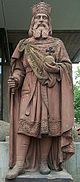
Charlemagne, King of France (742-814)
Yes, THE Charlemagne.
But that is not all. Continuing further back we find several Roman Emperors in these lines as well.
So what do we make of all this? The Church has a phone number to call for help. I called and asked how correct is this information known to be. I got the answer I expected, back to 1600 or so, its probably pretty good, before that doubtful. Still, it only takes one person to have made a connections from 1600 to 1300 when the royals show up. I would say that this is very doubtful, but also very interesting as a new avenue to research further.
Who knows what might show up?
Wednesday, September 5, 2012
HISTORY OF CHESTER COUNTY, PENNSYLVANIA. BY J. SMITH FUTHEY AND GILBERT COPE 1881
FLEMING, WILLIAM, the earliest member of this family in Chester County, was a native of Greenock, Scotland. It is related that he had an uncle who, in the latter part of the seventeenth century, sailed a ship from Greenock to the Eastern Shore of Maryland for tobacco and wheat. Once while in port at Greenock he persuaded his nephew, William Fleming, to make a voyage with him to America. He consented, and arriving in the Chesapeake in the harvest-time, went ashore at the instance of his uncle to help the farmers, as it would be some time before the ship would be ready to make the return voyage. While thus engaged the ship sailed without him, and he then learned that his uncle had bound him as a servant. He took the matter philosophically, served the farmer faithfully for the time agreed upon, and then made his way to the settlements on the Delaware. Here he resided with an Englishman, Richard Moore, in Concord township, (now) Delaware Co., and married Mary, one of his daughters. In 1714 he removed with his family and settled in East Caln township, Chester Co. The family possessions were at first on the east side of the west branch of the Brandywine, at and near the present Coatesville. Here he erected a dwelling, about where the rolling-mill of Huston & Penrose now stands. The first survey to William Fleming is dated May 29, 1714, and was for 207 acres and allowance, and he soon thereafter became the owner of a tract of 400 acres. The family subsequently became the owners of large tracts on the west side of the creek, in Sadsbury and West Caln, and their possessions extended along the valley on each side of the stream for a considerable distance. William Fleming died before 1733, leaving sons— John, William, Henry, George, James, and Peter— and daughters, Mary, wife of David Cowan, and Susannah, daughter of William Cowan.
George Fleming, one of the sons, became the owner of a tract in West Caln, containing 230 acres, by warrant dated June 14, 1744, and, as recited in a subsequent conveyance, "built and erected a water corn-mill, bolting-mills, mill-house, and other improvements upon the same land." He died unmarried, and the land descended to his nephew James, the eldest son and heir-at-law of his brother John, then also deceased, who was the oldest brother of George. Peter was the youngest son of William Fleming. He and his sons after the Revolution removed to Washington Co., Pa.
James Fleming, son of William Fleming, the emigrant, died May 3, 1767, at the age of sixty-four years, and was buried at Upper Octorara, leaving a son, John Fleming, who was born in 1731. This John Fleming, known in after-life as John Fleming, Sr., resided on a farm a short distance west of Coatesville, where he erected a large stone house, in the gable end of which is a stone bearing his initials and date of erection. He was an officer in the provincial service, member of the Constitutional Convention of 1776 to frame a constitution for Pennsylvania, and in 1778 one of the Representatives from Chester County in the General Assembly. He was one of the patentees of the land belonging to Octorara Church, of which he was an elder as early as 1762. He died Sept. 2, 1814, at the age of eighty-three, having been a church elder fifty-two years.
John Fleming, Jr., was a son of John Fleming, Sr. He was engaged as a wagon-master in the army during the Revolution, and was present at the battle of Brandywine. He became an elder in Upper Octorara Church in 1799, and died in December, 1832. It will be noted that he and his father served as elders in the church at the same time, about fifteen years.
Another son of John Fleming, Sr., was the ancestor of John Fleming, who was for many years an associate judge of Lycoming County, and of Gen. Robert Fleming, of Williamsport, a leading lawyer, who served in the Senate of Pennsylvania and was a member of the Constitutional Convention of 1838. Another John Fleming, called, to distinguish him from the others of the same name, "John Fleming of East Caln," died June 16, 1830, at the age of sixty-nine years.
Henry Fleming, Esq., in after-life of West Chester, was a son of John Fleming, Jr., and was born in Sadsbury township. For many years he was acting magistrate, selected by common consent, less for sought-for popularity than for acknowledged private worth, strict integrity, and inflexible character. When a young man he was a volunteer in the war with England of 1812–14, was made captain of a company, marched to Canada with Gen. Brown, was captured and taken to Quebec, where he remained a prisoner of war for the period of eighteen months. Returning to his home at West Chester, he carried on the business of a currier, taking a lively interest in all local and public affairs. A man of few words, he was a person of much thought; he read the newspapers of the day, and few were more familiar with modern and ancient history, with the high virtues of ancient Greece and Rome, of which he was a student and great admirer, evinced as well by his own stern virtues as in the names of his children, among whom we find a Solon, a Marcellus, a Fabius, and a Lucretia. The inspired songster of Israel was not more devoted to sacred music, a science which he cultivated from youth to age. He was one of the founders of the Presbyterian Church of West Chester, of which he was a pillar, and remained a faithful member until, "like a shock of corn fully ripe, he was gathered into the garner." He died in 1865, at the age of eighty-two years. His wife was Letitia Parke, a daughter of Joseph Parke, Esq., of Sadsbury township. She died Dec. 20, 1858, in the eightieth year of her age.
George Fleming, another son of John Fleming, Jr., resided in West Brandywine for many years. He was a much-esteemed elder in the Fairview Presbyterian Church.
The descendants of William Fleming, the original settler, are numerous and widely scattered, but none of them now possess any part of the landed estates of their ancestor.
Friday, August 31, 2012
Flemings at Fort Horn
This stockaded fortification was situated on a commanding point of land on the West Branch of the Susquehanna river, in what is now the township of Wayne, Clinton county, one mile west of the post village of Pine. At this point the river describes a great bend, affording a commanding view for about one mile up and down the stream from the elevation or point on which Samuel Horn chose to erect his stockade. Looking across the river to the north, which, at this point flows to the east, a magnificent view of the rich, alluvial valley is afforded; in the rear, not more than one-fourth of a mile away, is the dark and somber range of the Bald Eagle Mountain, varying in altitude from five to seven hundred feet.
At the time Samuel Horn settled here the river was the Indian boundary line, according to the provisions of the treaty of 1768, therefore, he was on the northern boundary of the Province of Pennsylvania. From the point where he built his cabin he could look over the Indian possessions for miles and plainly see the cabins of a dozen or more sturdy Scotch- Irish squatters on the "forbidden land."
Horn, when the Indians became threatening in 1777, with the assistance of his neighbors, enclosed his primitive log dwelling with stockades, and it became a rallying point as well as a haven of safety, in the perilous times, which followed. The enclosure probably embraced a quarter of an acre, thereby affording ample room for a number of families.
Tradition says that Horn's was a defensive work of no mean importance at that time, and was of great value to the pioneers who had pushed their way up the river. Its location was admirably chosen. In all that region no more eligible position could have been formed. Standing on its ramparts, the eye swept the river right and left and the Indian lands to the north, for several miles. As the current bore immediately under its lea an Indian canoe could scarcely have glided past in the night without having been detected by a vigilant sentinel.
One of the most remarkable incidents of Revolutionary times - an incident which stands, so far as known, without its counter part in the history of the struggle of any people for liberty and independence, occurred within sight of Horn's fort, but across the river on the Indian land. This was what is known as the "Pine Creek Declaration of Independence." The question of the colonies throwing off the yoke of Great Britain and setting up business for themselves, had been much discussed, both in and out of Congress. The hardy Scotch Irish settlers on both sides of the river, in the vicinity of Horns, bore little love for the mother country. The majority of them had been forced to leave their native land and to seek a home where they would be free from religious oppression - where they could worship God according to the dictates of their own conscience. They were all patriots in the broadest sense of the term, and a Loyalist or Tory would not have been tolerated in their midst. They yearned for independence, and when the discussion of the subject waxed warm they resolved on calling a public meeting to give formal expression to their views. Accordingly, on the 4th day of July, 1776, the meeting, assembled on the Pine creek plains and a resolution was passed, declaring themselves free and independent of Great Britain. The remarkable feature of this meeting was that the Pine creek resolution was passed on the same day that a similar resolution was passed by the Continental Congress sitting in Philadelphia, more than two hundred miles away, and between whom there could be no communication for concert of action. It was, indeed, a remarkable coincidence - remarkable in the fact that the Continental Congress and the squatter sovereigns on the West Branch should declare for freedom and independence about the same time.
It is regretted that no written record of the meeting was preserved, showing who the officers were and giving the names of all those present. All that is known is what has been handed down by tradition. The following names of the participants have been preserved: Thomas, Francis and John Clark, Alexander Donaldson, William Campbell, Alexander Hamilton, John Jackson, Adam Carson, Henry McCracken, Adam DeWitt, Robert Love and Hugh Nichols. The meeting might have been held at the cabins of either John Jackson or Alexander Hamilton, as both were representative and patriotic men of the period. Several of these men afterwards perished at the hands of the savages; others fought in the Revolutionary Army and assisted in achieving the Independence which they had resolved the country should have.
The majority of these men lived across the river from the fort on the Indian land, and they all received patents for the land they had preempted after the treaty and purchase of 1784, in consideration of their loyalty, patriotism and devotion to the struggling colonies. The name of Samuel Horn is not found among those that have been handed down to us, but it may be safely inferred that the man who was sufficiently patriotic to build a stockade fort for the protection of the neighborhood in which these men lived, was a sympathizer, if not a participant, in the Pine creek movement for independence.
There is nothing on record to show that the fort was ever supplied with small cannon. Its only armament was muskets and rifles in the hands of the hardy settlers when they had collected there in times of danger. That the savages regarded it with displeasure, and sought more than one opportunity to attack the occupants, there is abundant proof. They prowled about in small bands or laid concealed in the surrounding thickets ready to shoot down and scalp any thoughtless occupant who might venture a few hundred yards from the enclosure. Among the thrilling escapes that have been preserved is that of the young woman named Ann Carson, just before the flight known in history as the Big Runaway. She ventured out of the fort one day and was fired upon by a concealed savage. The bullet cut through the folds of her dress, making fourteen holes in its flight, but left her uninjured. About the same time another young woman named Jane Anesley, while engaged in milking a cow one evening outside the enclosure, was fired at by a lurking Indian several times. One bullet passed through her dress, grazing her body so closely that she felt the stinging sensation so severely that she was sure she was shot.
At the time Colonel Hunter sent up word from Fort Augusta for the settlers to abandon the valley and flee to places of safety down the river, as he was informed that a large body of savages was preparing to descend from the Seneca country to devastate the valley and wipe out the settlements, that fearless scout and intrepid soldier, Robert Covenhoven, bore the unwelcome news from Fort Muncy to Antes Fort and had a messenger dispatched from the latter place to warn the inmates of Fort Horn that they must fly if they valued their lives. The meager records informs us that all the settlers within a radius of several miles were collected at Horn's and that a great state of excitement prevailed. Those living on the Indian lands across the river were gathered at the fort, anxiously awaiting news from below. Judging from the extent of the settlements at the time, a hundred or more fugitives must have been collected there.
The order to evacuate the fort was received with feelings of alarm, well nigh bordering on despair. The frenzied settlers at once set about making preparations to abandon their humble homes, their growing crops - for it was in early June - and fly. Many of them buried chinaware and other household effects that they could not well carry with them in places that they could recognize if they were ever permitted to return.
Soon after receiving Colonel Hunter's message four men, Robert Fleming, Robert Donaldson, James McMichael and John Hamilton started down the river in canoes for Antes Fort to secure a flat in which to transport their families below. They were squatters on the Indian land across the river from Horn's and they knew that the savages had a grudge against them for trespassing on their territory, and that they would fare badly if they fell in their hands. The dread of impending danger had driven them across the river with their families to seek the protection of the fort.
They reached Antes Fort in safety, engaged a flat and started on their return. But the eye of the wily savage was on them. They had pushed their canoes up through the Pine creek riffles, when they pushed over to the south side of the river for the purpose of resting and to wait for other parties who were following them with the flat. At this point the mountain comes down almost to the edge of the river, and at that time it presented an exceedingly wild and forbidding appearance. As they were about to land, and not suspecting danger, they were suddenly fired on by a small band of savages concealed in the bushes. Donaldson jumped out of his canoe, rushed up the bank and cried to the others, "Come on, boys." Hamilton saw the Indians rise up, and at the same time noticed the blood spurting from a wound in Donaldson's back as he was trying to reload his gun. He soon fell from exhaustion and died. Fleming and McMichael were also killed. Hamilton, who was untouched, gave his canoe a powerful shove into the stream and, jumping into the water fell flat on the other side. Then, holding the canoe with one hand between the Indians and himself, he managed to paddle across the river with the other. Several bullets flew around his frail craft, but he escaped without a scratch. When he landed his woolen clothes were so heavy, from being saturated with water, as to impede his flight. He, therefore, stripped himself of everything but his shirt and ran swiftly up the river. His route was by the Indian path to the Great Island. He ran for life. Fear lent wings to his flight. The flutter of a bird stimulated him to increase his speed, and if a bush came in his way he cleared it with a bound. In this way he ran for nearly three miles, passing the place where his father had settled, until he came opposite Horn's fort, when he was discovered and a canoe was sent to rescue him.
The men in the flat being behind and hearing the firing and, divining the cause, hurriedly pushed to the north shore, below the mouth of Pine creek, which they hurriedly forded and ran up the path, which Hamilton had so swiftly traveled. James Jackson, who was one of the party on the flat, found a horse pasturing on the Pine creek clearing which he caught, mounted and rode up to the point opposite Horn's fort, when he was discovered and brought over in a canoe. The other men made their way to the fort and escaped.
An armed body of men, as soon as the news was received at Horn's, made their way down to the place of ambush. Here the dead and scalped bodies of Donaldson. McMichael and Fleming were found, but the Indians had departed. They knew that they would be punished and hurried away as quickly as possible. The rescuing party secured the three dead bodies of their neighbors and carried them to Antes Fort, where they were buried in the little graveyard, which had been started outside of the enclosure. Nearly all of the men left families, and the cruel manner in which they had been slain caused great excitement at the fort, as well as intense grief on the part of their wives and children. It was a sad day at Horn's. But no time was to be lost. Activity was the demand of the hour. The savages were emerging from the forests on every hand bent on murder and pillage, and the settlers collected at the fort saw that if they were to escape their relentless fury they must fly at once.
The same day the bloody affair occurred at Pine creek, a party of men were driving a lot of cattle down the river from the vicinity of the Great Island - the thickest part of the settlement on the Indian land - when they were fired on by a small body of skulking savages, almost in sight of Fort Horn. The whites, who were well armed, returned the fire, when an Indian was observed to fall and was quickly removed by his companions. This mishap seemed to strike terror into the ranks of the survivors and they fled precipitately into the forest, abandoning a lot of plunder, consisting largely of blankets, which fell into the bands of the whites. A member of the cattle party named Samuel Fleming, was shot through the shoulder and severely wounded. The Fleming family was one of the earliest to settle in this neighborhood, and as the head thereof had several sons, it is probable that Samuel was a brother of Robert, who was killed in the ambuscade at Pine Creek,
The firing was heard at Horn's and added to the alarm of the women and children assembled there, which only subsided when they found the party approaching on the other side of the river with their cattle. Fleming was ferried over to the fort, where he had his wound dressed. The cattle drivers continued on down the river in search of a place of greater security for their stock.
Such were some of the incidents preceding the Big Runaway in the latter part of June, 1778, when all of that part of the valley of the West Branch, west of the Muncy hills, was abandoned by the white settlers to escape the fury of the savages. The stockade forts, like the humble log cabins, were dismantled and burned, so far as the remorseless foe was capable of carrying out their intentions.
A description of the Big Runaway. which has no parallel in frontier history, is not out of place in this connection. The best account is found in Sherman Day's Historical Collections of Pennsylvania, p. 451. Mr. Day obtained it from the lips of Covenhoven himself in 1842, more than fifty years ago, when the thrilling incidents were comparatively fresh in his mind. After delivering the order of Colonel Hunter to the commander of Antes Fort, and seeing that the message was conveyed to Horn's, Covenhoven hastily returned to Fort Muncy and removed his wife to Sun bury for safety. He then started up the river in a keelboat for the purpose of securing his scanty household furniture and to aid the panic stricken inhabitants to escape. Day reports his story in these thrilling words:
"As he was rounding a point above Derrstown (now Lewisburg) he met the whole convoy from all the forts above (Muncy, Antes, Horn's and Reid's) and such a sight he never saw in his life. Boats, canoes, hog troughs, rafts hastily made of dry sticks - every sort of floating article had been put in requisition and were crowded with women and children and 'plunder' - there were several hundred people in all. Whenever any obstruction occurred at a shoal or riffle, the women would leap out and put their shoulders, not, indeed, to the wheel, but to the flat boat or raft, and launch it again into deep water. The men of the settlement came down in single file on each side of the river to guard the women and children. The whole convoy arrived safely at Sunbury, leaving the entire line of farms along the West Branch to the ravages of the Indians.
Thursday, August 30, 2012
Article - Centre Democrat, Bellefonte, PA on July 20, 1938
At the Fleming reunion held recently at Edgewood Park, Miss Harriet Strauser, historian, gave an interesting talk on the history of the Fleming family, Tracing it back to 1124, and up to, and including, 1863.
From the latter date to 1938 she has little information and Miss Strauser is endeavouring to have it looked up in Harrisburg so that the family history will be completed to date for the next reunion in 1939.
The history of the family as told by Miss Strauser, is as follows:
Elizabeth Fleming, wife of John McCormick, was the daughter of John Fleming, who descended from the Earl of Wigtown. Descendants of John Fleming still use and prize his coat of arms. Mr. Fleming was among the early settlers of West Branch Valley. The surname of the Fleming family, according to the sentiments of the most approved historians and antiquarians, was at first assumed from a person of distinction who, in the days of King David, 1124, a Fleming by patron moved himself into Scotland and took the surname Flandrensis or LeFleming from the county of his origin. Robert LeFleming, the direct and immediate ancestor of the Earls of Wigtown, was one of the great barons of Scotland under King Edward of England, 1272-1309.
In Furness Abby, England, an ancient burial place of the Fleming family, may be seen the statue of an armed knight which represents the Fleming family. Robert C. Fleming was succeeded by his son Sir Malcolm Fleming, Lord of Fulword, also in great favor with the King who made him a large grant of land in Wigtonshire and also Governor of Dunbarton Castle and Sheriff of the County. He was succeeded by his son of the same name as Governor, and during a battle had the honor of shielding Robert, Lord High Stewart of Scotland, who afterward became King. When he died he left his estates and titles to his grandson, Thomas Fleming, second Earl of Wigtown. He was slain in service of his country at the battle of Pinksy, September 10, 1545. Before his death, he married Janet, daughter of King James VI and by her had a son, James Fleming who, being a nobleman of fine and polite parts, was by special favor of Mary, Queen of Scots, made chancellor. He accompanied Mary to Scotland and died in Paris.
Sir Thomas Fleming, son of the Earl of Wigtown, came to Virginia in 1616 and later many of the family followed him, one of whom was Col. William Fleming and another the father of James Fleming who was born in Iredell County, N. C., in 1762. He served in the Revolutionary War and afterwards was sent to Ohio, where he died in 1832. He was the great grandfather of Hon. Josiah Mitchell Fleming of Denver, Colo. Another descendant of these Wigtownshire Flemings was Col. John Fleming, who migrated from Virginia to Kentucky in 1790. He was the grandfather of Hon. John David Fleming, late District Attorney for Colo. A grandson of Sir Thomas Fleming moved to Chester County, Pennsylvania, and located upon which is known as London Cross Roads. Here his son John married and a son was born and named John Fleming. This young man visited this valley and purchased a piece of land and erected his home. He died in his home leaving to survive six sons and three daughters and by a provision in his will the tract of land was given to Dr. Francis Allison who divided it into nine equal shares for the children. Lock Haven is now built on lots 4 and 5.
This was as much information available about the family and if efforts prove successful, the family tree will then be traced to 1938.
Fact Check: Dr. Francis Allison sold the land to John Fleming, there is no provision in his will as mentioned. According to the other information I received it was William Fleming who lived in Chester County PA at London Cross Roads. His son was Squire John, not his grandson. Squire John's will mentions eight children, not nine, however, it was common to lose children at early ages for various reasons such as disease, infection, etc.
Lastly, the Fleming who came by patron was likely sponsored by William the Conqueror when he became King of England. Previously he had been ruling in Normandy which is located close to Belgium, which is the "location" mentioned above. Also, the Robert mentioned, is Robert the Bruce.
Wednesday, August 29, 2012
David Fleming adopted? Nope!
Naturally, I dove into this right away. This week I received a copy of "The Profiles of the Fleming family in Lycoming, Chester and Northumberland, Pennsylvania" from the Pennsylvania Historical Society.
It provided a bigger scoop than just the answer to this adoption issue. First, to answer the adoption question, David was only 13 or 14 when Squire John Fleming died in 1777. He was named in his father's will to receive 200 acres of land. The court records show that his brother John Fleming was appointed as his guardian. At that time, since there is no mention of, or provision for, John's wife in his will, it must be assumed that she preceded him in death. His young age must have required the appointment of one in particular since he was now a land owner. So his brother John Dolan Fleming was appointed as his guardian.
The packet I received also included a number of historic references, newspaper articles, pictures and a family tree. It was a trove of information. Much of it centered around the descendants of John Dolan Fleming, for whom Flemington, Pennsylvania is named. But some information was provided about the ancestry of Squire John Fleming as well.
Squire John Fleming was one of three sons of William Fleming and Mary Moore, the daughter of William Moore. His brothers were Robert (1730-1778) and George (b 1732). According to the file, William migrated with his family to America about 1732 and settled in Chester County, Pennsylvania. Sadly, he died shortly after arriving.
All three sons would play key roles in the American Revolution. Squire John was a member of Bald Eagle Township's Safety Committee. Robert became a Lieutenant in the Continental Army and was killed at Fort Horn in 1778. Youngest brother George enlisted as private in Chester County, Pennsylvania for the Continental Army.
This is just the tip of the iceberg on this package I received. More posts to come.
Thursday, July 12, 2012
John Fleming's Life in Bald Eagle Township
By William Pencak
Selections:
Page 128 to 130
The earliest surviving assessment of Bald Eagle Township is a list from 1774 of one female (a widow named Dewitt) and thirty male proprietors, which records the size of their property in acres, the number of acres they had improved, and the number of horses and cattle they owned. Most names on the list appear to be of Scots-Irish and English descent, although at least two men, Gershom Hoff and Anthony Saltsman, were probably German. At least seven of the men share one of two family names, Fleming or Wilson, and are either related as brothers or fathers and sons. One man, Abraham Dewitt, was a tenant of John Fleming, Esq. The average size of an individual’s landholdings was approximately three hundred acres, although one was as small as fifty acres. Several had holdings consisting of 100, 150, or 200 acres, and John Fleming, Esq., had more than a thousand acres. On average, these property holders had improved about eighteen of their individual properties, which indicates that most farms were designed for subsistence. Property improvement could mean as little as a mark on a tree or as much as land cultivation or home construction. In several cases the owners had improved five or fewer acres. John Fleming had improved 143 acres. Twenty-eight of the listed settlers had on average two horses and two cattle.
Through the Eyes of the Preacher
Phillip Vickers Fithian (1747-1776) provides an account of the New Purchase region in the manuscripts of his supply ministry, which extended from the Shenandoah Valley up through Mercersburg and Sunbury in Pennsylvania along the West Branch of the Susquehanna River. Trained at Princeton from 1770 to 1772, Fithian began his journey on May 9, 1775, three weeks after the battles of Lexington and Concord, and passed along the West Branch of the Susquehanna to the home of John Fleming, Esq., on July 25, 1775. Although a bit melodramatic at times, or perhaps influenced by his prejudices against the Native Americans, his affinities for the colonial cause, and his disdain for backcountry living, Fithian’s selective observations offer interesting details for the study of this part of the frontier and the nature of its settlement.
When Fithian passed through the region, he found a land and its diverse peoples in transition, somewhat foreign to him, and not fully understood. He followed the West Branch of the Susquehanna to where it meets Pine Creek and noted the long clearing on either side of the creek, where he had been told Indian towns once existed. In their place Fithian found the cattle and horses of European settlers grazing on what he called a common. At John Fleming’s place, Fithian found the largest tract in the region, which included all the land between the Bald Eagle and Susquehanna to more than two miles upstream, where the Fleming house stood on the riverbank. Upon inspection, Fithian suspected that Fleming’s property included the site of the former Native American settlement across from Great Island and a clearing of more than 100 acres that the Indians had made long before the arrival of the European Americans.
Fithian also made note of various people he met on his journey. On the way to “Squire Fleming’s” at dusk on July 25, 1775, Fithian met an “Indian Trader” and his companion, who were passing over Pine Creek. The man rode on horseback armed with a “bright rifle,” followed by a horse with packs and “his Man” with their luggage. Fithian also saw two Native Americans on the first full day of his stay with the Fleming family. He experienced an unpleasant feeling when he viewed these “heathenish savages”, but he also noted that they carried “clean Riffles” and were headed downriver with skins (probably for trade with the European settlements).
Fithian kept notes on the nature of the homesteads, which provide insights into the nature of the household, the division of labor, the situation of the home in relation to the surrounding settlements, and the political, regional, and even global connections implied. Squire Fleming went to work in the fields well before 7:00 am, when the women began working in the same room where Fithian slept, waking him in the process. Fleming’s daughter helped with the milking and his niece helped with the reaping. The Flemings’ home was also a way station for people traveling through the region and a place where settlers’ families could socialize. On the second day of his stay, Fithian recorded Squire Fleming’s hope that the sparse settlement would “soon form to society.” That evening, Fleming’s brother and his family joined them all for dinner.
On the fourth evening of his stay, July 28, 1775, Fithian described his visit with the family of William Read, where he ate a dish of huckleberries and drank coffee, which Fithian noted was a rare commodity for the region. The same evening Fithian returned to the Flemings’ home to meet a Mr. Gilaspee, who had just arrived from Northumberland with the latest gossip about a local couple’s infidelity. On the evening of the next day Fithian recorded his conversation with a young gentleman, Mr. Waggoner, who had arrived at the Flemings from Pennsylvania on his way upriver with a surveyor. In the late afternoon William Read’s daughter, Jenny joined Fithian, John Fleming’s daughter, Betsey, and Mr. Gilaspee for a trip over the river and up the mountain to collect huckleberries. On their return across the river, Mr. Gilaspee purposely overturned the canoe in a “rare Diversion”, throwing the women and the fruit into the shallow current. Their diversion became a water fight that ended in Mr. Gilaspee’s submission, as many people watched from the shore. In the “Squire’s Library” Fithian also noted John Dickenson’s Letters from a Farmer in Pennsylvania to the Inhabitants of the British colonies (1767-1768), which criticized British colonial policy and suggested resistance, though not necessarily independence. In his journal entry for July 28, 1775, Fithian also expressed his concern for “poor distressed Boston, to the Eastward.”
On Sunday, July 30, at 11:00 am, Fithian held a worship service for approximately 140 people on the “Indian Land” along the north side of the Susquehanna River, opposite the Great Island. He stood at the base of a large tree and his congregation sat on the grass and in the bushes around him. In his journal he recorded three points that he stressed in his sermon” observation of the Sabbath, regular attendance, and the establishment of a more permanent ministry. Fithian provided no further information about the nature of the people gathered at this worship service. It is interesting to note that he held the service outside the officially designated territory of the Pennsylvania New Purchase. Most people were probably of European descent, although it is not clear how many were officially settled on the New Purchase tract and how many were squatters. It is also likely that Native Americans were present, given Fithian’s description of another service he held later at the Boggs homestead further up the Bald Eagle Valley. This suggests a greater level of interaction between Native Americans and Europeans, centered around the Christian religion, for this time and place than the current historiography, which stresses sharp racial divisions, suggests.
On the following Monday, Fithian traveled with Mr. Gilaspee up the Bald Eagle Creek. Before leaving, John Fleming paid Fithian twenty shillings for his “Supply,”
Wednesday, October 12, 2011
Pocahontas
Tuesday, October 4, 2011
More Pennsylvania Information
All of this information was found in "Past and Present of Clinton, County, Pennsylvania".
" Prominent among the early settlers of the West Branch Valley was John Fleming. He was a descendant of the Earl of Wigton, a Scottish Nobleman. His ancestry can be traced back to the fourteenth century. In 1773 he secured possession of a large tract of land lying between the Susquehanna river, and the Bald Eagle creek, which is the land upon which the city of Lock Haven and Part of Flemington now stands. His territory was a part of Dr. Francis Allison Tract. After the death of John Fleming which occurred in 1777, his land consisting of over 1000 acres was divided among his five sons and three daughters, namely Joseph, John, David, Robert, Ezekiel, Mary, Elizabeth and Rosanna. John Fleming built a house on the bank of the Susquehanna, near the abutments of the dam, where he died in 1777. Several hearth stones of the chimney of this house were found by workmen in excavating for the erection of the abutments at the time the dam was built, nearly half a century later.
His son the Hon. John Fleming, who came to this section in 1773. was appointed to the associate judgeship of Lycoming county by Governor Mifflin, in 1798. He was a native of Chester County, Pa, and born near the London Cross Roads, He was married to Susan Chatham, a daughter of Col. Chatham who at one time owned a mill and large tract of land at Chathams Run. Mrs. Fleming was born in Dublin, Ireland, coming to this county when an infant she died in 1824. Hon. John Fleming had nine children, namely, General Robert Fleming, John Fleming, who was one of the first associate judges of Clinton County, Algernon Sydney, who was sheriff of the county, from 1866 to 1869, Exekiel, who went to Kentucky in 1833, William, who died at Alton, Illinois in 1846, Sarah, who Married Joseph Montgomery, Nancy who married David McCormich and Mary, who was the wife of Hon. Joseph Quay
Land Holdings:
Land; Grantee index, Northumberland Co., PA; John and Robert Fleming, grantees, Nehemiah Breese grantor; Vol. D page 8; 26 Sep 1777; 6 Sep 1787;
Biographical; John Fleming (who died in 1777); "The Fair Play Settlers of the West Branch Valley 1769-1784; A Study of Frontier Ethnography" by George D. Wolf, 1969, F157.L9W6; BYU-Idaho. P. 67, "However after the treaty one Presbyterian minister, the Rev. Francis Alison, pastor of the college of Philadelphia, applied for land above the mouth of Bald Eagle Creek and was granted some 1500 acres. Alison never came into the region and,in fact, sold his entire purchase to John Fleming in 1773." (The author cites 'History of Centre and Clinton Counties' by John Blair Linn, page 520.)
Page 53 Refers to Squire Fleming's daughter Betsey, and says the Squire had "two fine daughters (including Betsey).
Page 77 (Referring to their roles in the Revolutionary War) Robert Fleming was a regional leader, John Fleming was a local leader.
Page 81 (Regarding Robert Fleming and his several leadership positions): "During the revolution he was primarily concerned with the area around the Great Island (in the West Branch of the Susquehanna, near Jersey Shore), serving at Reed's Fort (present Lock Haven) and on the Fleming estate, which some referred to as Fort Fleming. Robert had a brother John...Their combined holdings ran to almost 3,000 acres of which 1,250 was Robert's."
Page 82 John Fleming actually resided outside the Fair Play territory, on the Provincial or State side of the Susquehanna (he lived on the north or west side). He died in 1777.
Monday, September 19, 2011
Famous Flemings
Select Fleming Names
Sir Thomas Fleming was the Lord Chief Justice who sentenced Guy Fawkes and the gunpowder plotters in 1605.
Thomas Fleming was the Catholic Archbishop of Dublin in the early 17th century.
Michael Fleming, a Catholic bishop, was regarded as the most influential Irish immigrant to have come to Newfoundland in the 19th century.
Sir Sandford Fleming was a Scots-born Canadian engineer and the creator of Standard Time.
Robert Fleming was a Scots financier from Dundee who founded the merchant bank Robert Fleming & Co.
Sir Alexander Fleming was the discoverer of penicillin in 1929, for which he was awarded the Nobel Prize for medicine in 1945.
Victor Fleming was the director of two classic American films, Gone With The Wind and The Wizard of Oz.
Ian Fleming was the novelist and creator of James Bond.
Tommy Fleming from Sligo is one of Ireland's top singers.
Select Flemings Today
Possible Royal Kinship

While Squire John Fleming is as far back as I have been able to get in our Fleming family tree, there is evidence that he descends from Scottish royalty. Here is a citation to make the argument:
From Linn's County History of Clinton, Pennsylvania
Prominent among the early settlers of the West Branch Valley was John Fleming, he was a descendant of the Earl of Wigton, a Scottish nobleman. The families descended from him still prize and use the earl's coat of arms. This very year (the year, John McCormick came to the neighborhood) he entered into the possession of the large track of land lying between the Susquehanna River and the Bald Eagle Creek, on which the city of Lockhaven now stands and part of the borough of Flemington, which he had purchased of the Rev. Dr. Francis Allison. After his demise which occurred in 1777, his land containing over 1600 acres was divided among his five sons and three daughters. John Mc Cormick, who had married his daughter Elizabeth, subsequently purchased the part that fell to her brother Joseph.That was the part commonly known as the "point" lying immediately west of the junction of the Susquehanna with the Bald Eagle.
The royal connections for the Earl of Wigton are well documented. The Earl of Wigton was descended from King James V of Scotland. If you climb his tree further you will find a daughter of the famous rebel Robert The Bruce who married James I of Scotland.
While this is a citation, it is far from complete. It indicates this lineage but we do not know what the exact family tree was and, therefore, still must look for proof.
This is not the only royal connection to the Flemings. The Bartlett family is said to descend from William the Conqueror. the first Norman King of England, pictured above. He lived from 1028 to 1090, about. While this is a very long time ago, it is not that far fetched. The Bartlett family had a chapel on their property in England within which was a bible recording the previous 300 years of baptisms, marriages and deaths. This would take us back from 1600 to 1300, and someone as famous as this would be remembered for that long.
Goodeth Gilman is said to be related to royals and Mary Stearns is said to descend from the last queen of Albania. I have listed these ladies in my lineage previously.
But, in all of these cases, we have to look much further for definitive proof.
Wednesday, September 14, 2011
Squire John Fleming
Pictured here is the current view from John Fleming's land on the Susquehanna River near Lock Haven Pennsylvania. As you will see from his will he owned quite a large tract of land. He and his wife Mary had eight children. His son David is the one from which I descend. One of his children, John, went on to become a judge. Flemington, Pennsylvania is named after him.His will was written May 1, 1777. He died a few days later, May 6, 1777. It remains on file in the county records of Northumberland County located in Sunbury, Pennsylvania.
In the name of God Amen, I, John Fleming, of Bald Eagle township, in the county of Northumberland and the state of Pennsylvania, farmer, being sound in mind and memory, thanks be to Almighty God for his mercies. but at the same time knowing the uncertainty of this fleeting and transitory life, and do make and publish this my last will and testament in manner following, that is to say;
First: I recommend my soul to God that gave it, and my body I commit to the grave; I desire that after my decease, that my just debts be paid, and I give and bequeath until my well beloved son Robert Fleming the place whereon William Reed now lives of two hundred acres, and to my well beloved son Joseph Fleming two hundred acres at his choice, except the place I live on; and to my well beloved daughter Rosana Jameson, one hundred acres of land or one hundred pounds as soon as conscience will admit, and to my well beloved daughter Elizabeth Fleming one hundred acres of land or one hundred pounds in money aforesaid,
And to my well beloved son John Fleming two hundred acres of land, and to my well beloved daughter Mary Fleming one Hundred acres of land or one hundred pounds to be paid in manner aforesaid. and to my well beloved son Ezekiel Fleming two hundred acres of land and to my well beloved son David Fleming the place whereon I now live, and the stock to be divided in equality among them, that are of age, and the aforesaid land to them their heirs and assigns forever, and I do order and appoint my BROTHER Robert Fleming Executor, together with my sons Robert Fleming and Joseph Fleming Executors, of this my last Will and Testament, hereby revoking all former Wills by me made, and do declare this to be my last will and testament. In testimony whereof I have hereunto set my hand and seal, this first day of May 1777 John Fleming signed in presence of us, John McCormick, William Reed, John Fleming (Seal)
His will was probated on June 13, 1777. There was no mention of any provisions for his wife, Mary, so she is presumed to have deceased before this time.
Tuesday, September 6, 2011
More Presidential Kinships
Thomas Perkins was born in England in 1525. Through the chart below, he became my tenth great grandfather. He is also connected to a number of U. S. Presidents.
Thomas Perkins is the 10th great grandfather of Calvin Coolidge(30), the ninth great grandfather of Franklin Delano Roosevelt(32) and Richard Nixon(37), and the eighth great grandfather of Millard Fillmore(13).
Here is the line of descent into the Fleming family;
My tenth great grandparents: Thomas Perkins = Alice Kebble
My ninth great grandparents: Henry Perkins = Elizabeth Sawbridge
My eighth great grandparents: John Perkins = Judith Gater
My seventh great grandparents: Rev. Thomas Wells = Mary Perkins
My sixth great grandparents: Moses Chase Jr. = Elizabeth Wells
My fifth great grandparents: Seth Chase = Elizabeth Bartlett
My fourth great grandparents: Rebecca Chase = John Bartlett
My third great grandparents: Silas Leland = Lucina Bartlett
My second great grandparents: Robert King Fleming = Lucina Leland
My great grandparents: Thomas H. B. Fleming = Ellen Giblin
My grandparents: John Leland Fleming = Margaret Finnegan
Sunday, September 4, 2011
Our Connections to various Presidents
My ninth great grandparents : John Wheeler - Agnes Yeomans
My eighth great grandparents: Aquila Chase - Anne Wheeler
My seventh great grandparents : Moses Chase - Anne Follansbee
My sixth great grandparents : Moses Chase Jr. - Elizabeth Wells
My fifth great grandparents : Elizabeth Bartlett - Seth Chase
My fourth great grandparents : Rebecca Chase - John Bartlett (cousins)
My third great grandparents : Lucina Bartlett - Silas Leland
My second great grandparents : Robert King Fleming - Lucina Leland
My great grandparents : Ellen Giblin - Thomas Hart Benton Fleming
My grandparents: John Leland Fleming - Margaret Finnegan
John Wheeler is the ninth great grandfather of:
1) Leslie Lynch King, Jr., whose name was legally changed to Gerald Rudolph Ford, Jr.,the 38th U. S. President,
2) George Herbert Walker Bush, 41st U. S. President and
3) Herbert Clark Hoover, 31st U. S. President.
He was also the tenth great grandfather of George Walker Bush, 43rd U.S. President, and the sixth great grandfather of James Abram Garfield, 20th U. S. President. All of this is straight out of Gary Boyd Roberts book "Ancestors of American Presidents" 2009 Edition.
There is another line that may connect us to a few more Presidents: Nixon, Coolidge, Fillmore and FDR. I have a little research to do on this line.
Thursday, September 1, 2011
Salem Witchcraft Trials 1692
One of the things that I was most surprised to learn was of our familial connection with the Salem Witchcraft Trials of 1692. This had never been mentioned by my mother as a possibility. However, once you trace your ancestry to families living in Massachusetts before 1700, pretty much anything is possible. There just were not that many people living in Massachusetts that early.
Once Gary Boyd Roberts had noticed the family name of Towne in our Fleming and Leland lines, he focused on this possibility.
There were three Towne sisters who were convicted of Witchcraft. They were all married: Sarah Towne Cloyse, Rebecca Towne Nurse and Mary Towne Estey(Esty). Mary and Rebecca were executed and Sarah was condemned but never executed. In referring to these three sisters, it should be noted that the state of Massachusetts paid the families a settlement less than twenty years after their death, for wrongful death. They were clearly the victims of some Puritan hysteria.
What Gary discovered for me is that Jacob Towne, brother to these three, was my 8th great grandfather. His father William Towne, father of the three, was my 9th great grandfather. This makes Mary, Rebecca and Sarah my eighth great grand aunts.
According to "The Towne Family" by Lois Payne Hoover,William Towne, son of John Towne and Elizabeth Clarke, was baptized March 18, 1598/99 at St. Nicholas Church, Great Yarmouth, Norfolk, England, and died before July 24, 1673 in Topsfield, Essex, Massachusetts. He married Joanna Blessing April 25, 1620, also at St. Nicholas Church. Joanna had been baptized June 22, 1595 at Holy Trinity Church, Caister-on-Sea, Norfolk, England. Her parents were John Blessing and Jone. Joanna died before January 17, 1682/3, in Topsfield. Neither William nor Joanna lived to see their daughters accused of witchcraft. Much of this research was attributed to the Parish Register of St. Nicholas Church. This register also confirms the baptisms of the first six Towne children and the burial of child Susan.
There is a Towne Family Association that has verified these facts over the years. The Towne family is now holding an annual family reunion. Next year, 2012, they will meet for a tour of the various locations in England where the family lived.
On September 26, 1635, William and Joanna were cited for failing to appear for communion at St. Nicholas Church, and were labeled "Separatists, William and Joanna Towne, his wife" according to the Norwich Consistory & Archdeaconry Visitation Records. The term Separatists meant that they were no longer attending church but did not mean they had left England.
William Towne is first seen in Massachusetts records in 1640 when he was granted ten acres of land in the Northfields area of Salem.
Here by generation is the Towne family in relation to me:
My ninth great grandparents: William Towne = Joanna Blessing
My eighth great grandparents: Jacob Towne = Catherine Symonds
My seventh great grandparents: John Towne = Mary Smith
My sixth great grandparents: Isaac Towne = Susannah Haven
My fifth great grandparents: John Haven = Susanna Towne
My fourth great grandparents: Lois Haven = Solomon Leland
My third great grandparents: Silas Leland = Lucina Bartlett
My Second great grandparents: Robert King Fleming = Lucina Leland
My great grandparents: Thomas H B Fleming = Ellen Giblin
My grandparents: John Leland Fleming = Margaret Finnegan
Tuesday, August 30, 2011
Flemings
Lets go back from Robert King Fleming. His parents were David Fleming and Eleanor King. Both fathers of this couple would be recognized for their contributions to the Revolutionary War.
David Fleming was the son of John and Mary Fleming. Mary's maiden name has been applied as McQueen, Sullivan and other names in various sources. We don't know definitively what her name was. John and Mary lived in Bald Eagle Township, Waterford County, Pennsylvania. During the early part of the year of 1777, John was elected to represent Bald Eagle Township on the county Safety Committee. This was the first election held under the democracy framed by the early patriots in Pennsylvania. For this patriotic service he was recognized by the Daughters of the American Revolution. Eleanor's father, Robert King, who came to this country when he was six years old from Donegal, Ireland, served as a Captain in the Continental Army. He was wounded and later received a pension.
John Fleming is as far as I have been able to go on this line and feel certain we have the right ancestor. I am sending off for his will which should still be on file in Waterford County. Hopefully it will shed some light on where he came from.
The Bartlett Family
Here is a list of the Bartlett line before it joins the Fleming family and where the signer of the Declaration of Independence fits into it.
Richard Bartlett III and Hannah Emery had two sons of interest to us, Stephen and Richard IV.
Stephen Bartlett was the father of Josiah Bartlett, pictured left, who signed the Declaration of Independence. Josiah was elected the first chief executive of New Hampshire. Later the title was changed to Governor. His portrait hangs in the New Hampshire state capitol building. His home in Kingston, New Hampshire is a national historic site. His statue is in the town square of his place of birth, Amesbury Massachusetts. Bartlett, New Hampshire was named in his honor. He was a medical doctor by profession. He also was on the committee that drafted the Articles of Confederation, the forerunner to the Constitution. He was also Chief Justice of the New Hampshire Supreme Court.
The other son of interest to us is Richard Bartlett IV, our direct ancestor and a first cousin of Josiah. The technical relationship between myself and Josiah is that I am his first cousin, seven times removed.
Richard Bartlett III and Hannah Emery were married on November 18, 1673. Their son Richard IV was born on October 20, 1676. Their son Stephen was born on April 21, 1690. Stephen married Hannah Webster on December 18, 1712, and their son Josiah was born on November 21, 1729.
Richard Bartlett IV married Margaret Woodman April 12, 1699. Their daughter Elizabeth Bartlett would marry Seth Chase.
(Note: The Bartlett family tree was very confusing to me for two reasons. First, there are quite a few Richard Bartletts, and second there was quite a bit of marriage involving first cousins. Our ancestor, Lucina Bartlett actually has Bartletts on both sides of her family tree. So, I am basing this information on notes written out for me by Gary Boyd Roberts who sorted through this. Gary based his notes on the book "The Descendants of Joseph Bartlett" and others. To ensure that I understood this, I photocopied many of the pages of books that were applicable.)
Elizabeth and Seth Chase would have a daughter, Rebecca Chase. Rebecca married, Gary believes, a cousin, John Bartlett. These were the parents of Lucina Bartlett who married Silas Leland. Their daughter Lucina would marry Robert King Fleming. For the Flemings I have previously shown the lines of descent.
Finding Our Signer
Almost all Americans named Leland trace their heritage back to Henry Leland who was born in England about 1625. He was a founding father of Sherborn, Massachusetts.
Henry and his wife Margaret (Badcock)had five children.
Henry’s son Ebenezer, born January 2, 1657/8 would be our Fleming ancestor. Other sons were two boys names Hopestill. One died in infancy and his brother was given the same upon his birth two years later. Eleazer was their fourth son and Experience was their only daughter.
Next in line would be Ebenezer’s son with Deborah Brazier, James Leland, who was born September 20, 1687. Deborah and Ebenezer had four children before Deborah died in her thirties. Ebenezer married a second time to Patience Rice having five more children with her. James, working as a farmer and Captain would marry Hannah Learned and their son Moses continues the line toward the Flemings.
Moses Leland was born in 1716 in Massachusetts. The family lived in various places which included Sherburne, Grafton and Sutton primarily. Moses married Abigail Robbins and they had nine children. Moses supported his family as a farmer.
Solomon Leland was the son of Moses and Abigail. He was born in 1742, lived in Sutton and was a farmer, church deacon and State Representative. Before he died in 1808 he would marry Lois Haven and they would have eight children.
It is at this point that the Leland family is about to accept into their ranks a relative of Josiah Bartlett, first Governor of New Hampshire and a Signer of the Declaration of Independence. Silas Leland was the sixth of the eight children of Solomon and Abigail. He would marry Lucina Bartlett. This couple would be the ones to leave Massachusetts for the midwest, living in both Wisconsin and Illinois. Silas worked as a blacksmith and “machinist” in New Diggings, Wisconsin near Hazel Green. At the time there was a lead rush in the area they settled. I believe that Silas used the plentiful supply to make metal parts for wagons and other equipment. Silas and Lucina would have five children: Candace, Lucina, Silas, Larinda and William H. Their daughter, Lucina Leland, born in 1808 would marry Robert King Fleming.
Robert and Lucina would have 6 children and would be the first of this line of ancestors to move to the Saint Louis area. Their youngest son was named after a family friend, Thomas Hart Benton Fleming would work as a printer and reporter in Saint Louis. He would marry Ellen Giblin and they would have six children, the second of which was my grandfather, John Leland Fleming born in 1875.
Here is a graph
Henry Leland = Margaret Badcock
(1625-1680)
Ebenezer Leland = Deborah Brazier
(1657-1742)
James Leland = Hannah Learned
(1687-1768)
Moses Leland = Abigail Robbins
(1716-1797)
Solomon Leland = Lois Haven
(1742-1797)
Silas Leland = Lucina Bartlett
(1781-died after 1850)
Lucina Leland = Robert King Fleming
(1808-1878) (1801-1874)
Thomas Hart Benton Fleming = Ellen Giblin
(1840-1923) (1853-1920)
John Leland Fleming = Margaret Finnegan
(1875-1919) (1880-1969)
This gets our line the families of the women who married into both the Fleming and Leland families, but it does not get us back to our Signer. So, in the next article, I will close in on Lucina Bartlett and her forebears.
My Week in Boston
As I began to do amateur genealogy work, I searched records online and found nothing to lead me to any signer. I had picked off all the easy stuff and had hit brick walls beyond that. In the summer of 2011 Nancy and I decided that I should go for some additional training to better help me gather more deeply hidden information. The New England Historical and Genealogical Association was offering a class “Come Home to New England” at their Headquarters in Boston. We debated the expense of the trip, cost of a hotel in downtown Boston for a week, plane fare and so forth. I am forever grateful that Nancy thought it was important enough to spend a considerable amount on this effort.
I attended the training last week and am committing what I learned with these postings. Our 20 or so students had a world class library at our disposal and a team of expert professional genealogists with whom to consult. We started each morning with a one hour lecture on a topic related to research. We spent very little time working on internet sources although I did pick up a few new places to look online. After our opening lecture with questions and answers following, we would move from the classroom to the library. NEHGS has a six story building. The first floor is a high ceiling rotunda, the second floor is their classroom area. The third floor houses their administrative offices while the fourth has their extensive microfilm collection. The fifth and sixth floors are their extensive libraries. These contain many family genealogies done by professional genealogists over the years and manuscripts, rare books and a variety of other books with historical references of all manner.
All of us had brought our own genealogy projects to work on so we would begin to do research. We would also be assigned a consultation with a professional genealogist of our choosing. There were ten available to us and we were given each of their specialties in advance. Inevitably these consultations would deepen our understanding of possible sources. In some cases they debunked the work that students had done before the class. Luckily in my case they did not find any problems with my work in advance.
We had one other invaluable resource at our disposal. The first morning, Gary Boyd Roberts, announced that he wanted to work with each one of us for at least two hours during the week. In order to accomplish this, he was going to be keeping the library open until 11:00PM every night. Gary is the author of several books on genealogy “Notable Kin”, “The Ancestry of U.S, Presidents” and others. He was born in Texas, educated at Yale and has spent his working life pretty much at NEHGS. Gary’s generosity with his time was the key to the discoveries I would make during this week.
So thats the background, now on to our Fleming family kin.